


Humphreys Peak: Arizona’s Skyward Challenge

July 2019
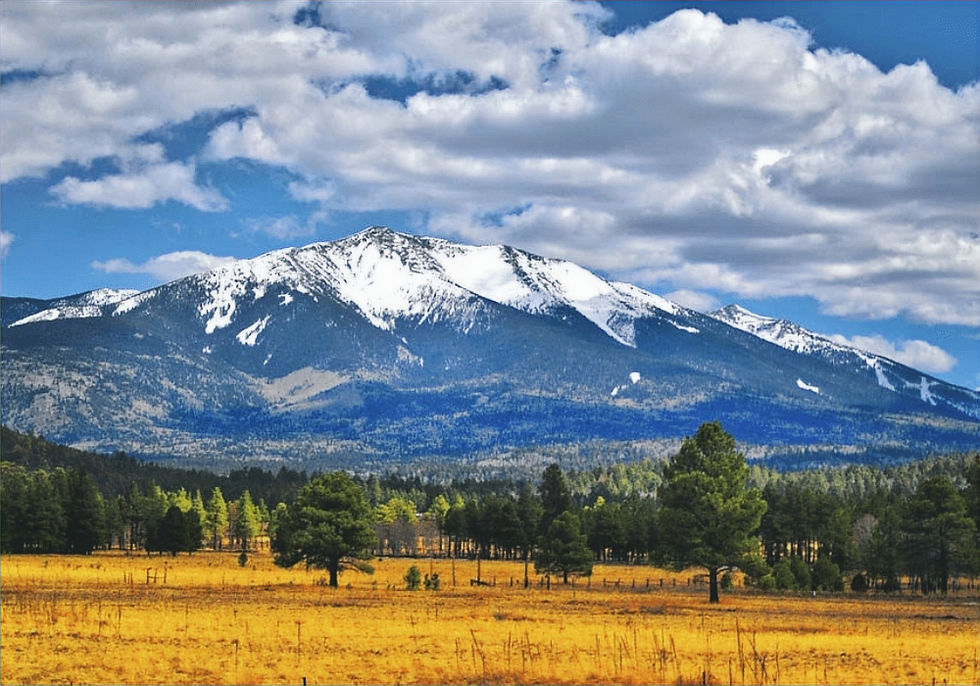
The first thing that hits you is the vastness. Northern Arizona stretches out like a painted desert beneath a deep blue sky, but your eyes are drawn upward—toward the snow-speckled summit of Humphreys Peak. At 3,851 meters (12,633 feet), it doesn’t rival the towering giants of the Andes, but here, in the high desert, the mountain commands attention.
Humphreys Peak is the highest point of the San Francisco Peaks, the eroded remains of a massive stratovolcano that once stood over 4,000 meters taller than it does today. This ancient volcano formed millions of years ago as part of a volcanic field linked to deep crustal processes in the Colorado Plateau. Over time, powerful eruptions, followed by a catastrophic collapse and erosion, reshaped the mountain into the peaks seen today. Humphreys Peak itself is the highest surviving remnant of that once-dominant volcanic structure.
Walking Through Time

Humphreys Peak is more than a climb—it’s a geological story written in rock, ash, and lava. The slopes whisper tales of eruptions long past, the remnants of a stratovolcano that shaped the San Francisco Peaks. Each step carries you from ponderosa forests through alpine meadows, then into the stark, wind-battered tundra that crowns the summit. Long revered by the Native peoples of the region, Humphreys Peak later drew the attention of 19th-century explorers and surveyors documenting the Colorado Plateau.
For many Native American tribes—including the Hopi, Navajo (Diné), Havasupai, and Apache—the San Francisco Peaks are sacred. They are considered spiritual beings and play a central role in ceremonies, origin stories, and seasonal traditions. The peaks are often seen as the home of deities or ancestral spirits, and climbing them carries cultural significance beyond recreation. This deep connection between land and identity remains strong today, adding another layer of meaning to the ascent.
The Ascent: Physical and Mental

Starting at the Snowbowl parking area, the trail gains over 1,100 meters in just five miles. Early morning is your ally: crisp air, soft sunlight, and the quiet rhythm of your own footsteps. But the mountain doesn’t give up its summit easily. The higher you climb, the thinner the air, the stiffer the wind. The trail narrows; your legs burn; your lungs scream. Every breath is a reminder that altitude, even moderate, changes the rules.
Above 3,200 meters, the landscape shifts. Trees disappear, replaced by jagged rock and open tundra. The wind whips across your face, carrying a cold bite that tests your focus. One misstep here isn’t catastrophic, but it’s a reminder that nature doesn’t forgive carelessness.
Practical Advice for Climbers
Start Early: Summer thunderstorms roll in fast. Begin before dawn to stay ahead of the storms.
Layer Wisely: Temperatures drop quickly above treeline. Windproof jackets, gloves, and head protection are essential.
Hydrate and Fuel: Even a moderate climb feels brutal without water and energy-rich snacks.
Gear Up: Hiking boots, trekking poles, sunglasses, sunscreen, and, in winter, crampons or microspikes.
Know Your Limits: Monitor altitude effects and weather changes. Turn back if conditions worsen.

Humphreys Peak isn’t the tallest mountain you’ll ever climb, but it delivers a complete alpine experience: the thrill of elevation, the challenge of rugged terrain, and the awe of standing above the world, even if just for a fleeting moment. Here, in the high desert of Arizona, touching the sky feels both intimate and infinite.
Height (4/10)At 3,852 m, it’s high enough to cause mild altitude effects for some hikers, but far below the extreme elevations where severe altitude sickness becomes common.
Technical Difficulty (2/10)No technical climbing required. It is a straightforward hike on a maintained trail to the summit, with no need for ropes or mountaineering skills.
Terrain & Route Complexity (3/10)The trail is well-defined but steadily steep, passing through forest, alpine meadow, and finally rocky scree near the summit. Navigation is simple in normal conditions.
Weather & Climate (6/10)Weather can be a real factor. Even in summer, conditions at the summit can be cold, windy, and storm-prone. In winter, snow and ice can significantly increase difficulty.
Accessibility & Remoteness (2/10)Very accessible from Flagstaff with a popular and well-marked trailhead. It is a commonly hiked peak with no permit complexity for standard ascents.
Final overall difficulty rating: 3.0 / 10
Humphreys Peak is a physically demanding but non-technical hike, where the main challenge is elevation gain and occasional weather exposure rather than altitude or climbing difficulty.



Comments