


Into the Wild: Climbing Gran Paradiso

Augustus 2020
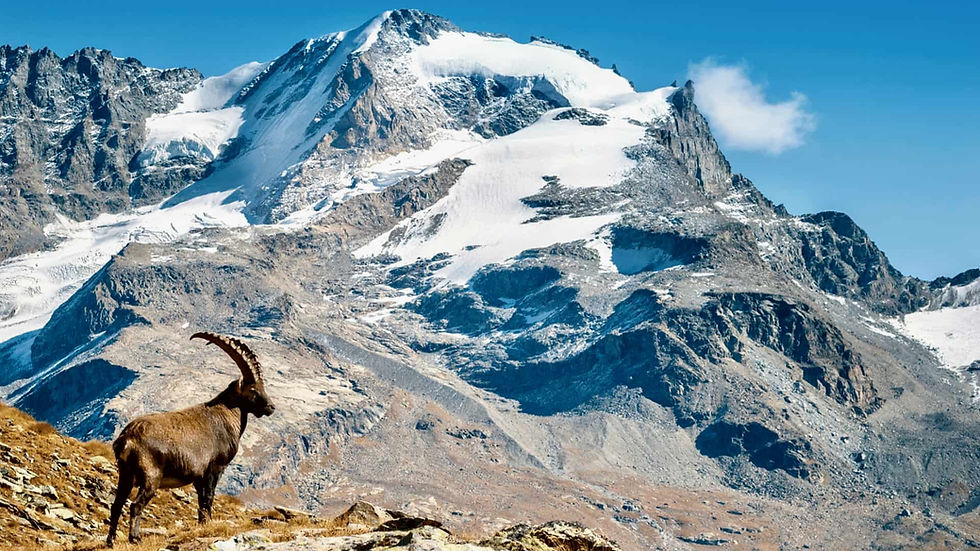
Nestled in the Italian Alps, Gran Paradiso rises to 4,061 meters, making it the only 4,000-meter peak entirely within Italy. Known for its stunning glaciers, rocky ridges, and abundant wildlife, it’s a playground for mountaineers seeking both beauty and challenge. But Gran Paradiso isn’t just about altitude—it’s about immersion in an alpine ecosystem that has been carefully preserved within Gran Paradiso National Park, Italy’s first national park, founded in 1922.
Geologically, Gran Paradiso is part of the Graian Alps, formed during the Alpine orogeny when the African and Eurasian tectonic plates collided. This immense pressure uplifted ancient metamorphic rocks—gneiss and schist—that were later sculpted by repeated Ice Age glaciations. These glaciers carved the deep valleys, sharp ridges, and hanging cirques that define the mountain today, leaving behind the dramatic alpine landscape seen by climbers now.
The Mountain and Its Majesty
Gran Paradiso is named after the “Great Paradise” of its rugged slopes, and it lives up to the name. Ibexes roam freely on steep cliffs, and marmots whistle across green alpine meadows. The first climbers in the 19th century were drawn not only by the summit but by the thrill of exploring uncharted terrain—a tradition that continues today.
The region’s ibex population is especially significant. Once nearly extinct due to overhunting in the 19th century, the Alpine ibex was protected thanks to royal hunting reserves established by King Victor Emmanuel II—whose former hunting grounds later became the foundation of Gran Paradiso National Park. This early conservation effort made the mountain one of Europe’s most important wildlife recovery success stories.

The standard ascent typically begins at Rifugio Vittorio Emanuele II, a charming stone hut perched at 2,732 meters. From here, climbers follow a trail that winds across glaciers, snowfields, and rocky ridges. The route demands endurance, good acclimatization, and respect for alpine hazards like hidden crevasses, sudden weather changes, and high-altitude fatigue.
Glacier Travel and Summit Approach
Gran Paradiso’s glaciers are beautiful but unforgiving. Mountaineers must be skilled in using crampons, ice axes, and roped travel. The Glacier of Gran Paradiso stretches below the summit ridge, reflecting sunlight that dazzles the eyes and turns every step into a careful negotiation with nature.
Like many Alpine glaciers, those on Gran Paradiso are retreating due to rising global temperatures. Over the past century, the ice has thinned and shrunk significantly, exposing new rock and altering traditional climbing routes. Crevasses that were once stable now open unpredictably, making modern ascents more technically demanding than those of early climbers.
Ascending the final ridge, you feel both awe and vulnerability. Exposed rocks, icy patches, and steep drop-offs create a thrilling mix of challenge and exhilaration. Each step is deliberate, requiring focus and respect for the mountain’s power.
Reaching the Summit

Standing on Gran Paradiso’s summit, you are rewarded with panoramic views of the Alps stretching into Italy, France, and Switzerland. Snow-capped peaks, winding glaciers, and sheer rock faces create a scene both humbling and inspiring. The summit is a silent celebration of human effort and the enduring grandeur of the natural world.
The summit area also holds symbolic importance in Italian mountaineering culture. Unlike many higher and more technical Alpine peaks, Gran Paradiso is often considered a “first 4,000er” for aspiring alpinists in Italy and beyond. Its accessibility combined with real glacier travel makes it a formative experience in European mountaineering tradition.
Practical Tips for Climbers
Acclimatize: Spend a night or two above 2,500 meters to reduce the risk of altitude sickness.
Gear Up: Crampons, ice axe, helmet, and rope are essential for safety.
Weather Awareness: Mountain weather changes rapidly; check forecasts and be prepared to turn back.
Hydrate and Fuel: Carry enough water and high-energy snacks; huts provide breaks but not full supplies.
Respect Wildlife: Ibexes and marmots are abundant—observe from a distance, don’t feed, and stay on marked paths.
Reflections on the Mountain
Gran Paradiso is more than a climb—it’s a journey into a pristine alpine world where humans are guests, not conquerors. Every glacier crossing, ridge scramble, and summit step is a lesson in patience, endurance, and humility. It’s a mountain that rewards respect and preparation, leaving climbers with memories etched as deeply as the grooves in the glaciers beneath their feet.
Height (5/10) At 4,061 m, it is a true alpine 4000er with noticeable altitude effects. Acclimatization is important, especially on summit day.
Technical Difficulty (5/10) This is one of the easier 4000m peaks in the Alps, but still requires basic mountaineering skills. Glacier travel, crampons, and ice axe use are needed for the normal route, though technical climbing is limited.
Terrain & Route Complexity (5/10) The route involves glacier ascent followed by a short but exposed rocky summit section with fixed chains. Navigation is generally straightforward with good conditions.
Weather & Climate (7/10) Classic alpine conditions: cold temperatures, strong winds, and sudden weather changes. The summit ridge can become hazardous in poor visibility or ice.
Accessibility & Remoteness (4/10) Accessible from the Valle d’Aosta region in Italy, with huts and established routes, but still a serious alpine environment requiring planning and overnight stays.
Final overall difficulty rating: 5.2 / 10
Gran Paradiso is often considered an entry-level glacier peak in the Alps, but still requires real mountaineering experience due to altitude, ice travel, and summit exposure.


Comments